Precision engineering-plastic parts
Nylon CNC Machining Services
Custom CNC milling and turning for PA6, PA66, cast nylon and selected filled grades. We plan tolerances around moisture, heat, stock stress and the part’s real service environment—not only the dry dimension measured at the machine.
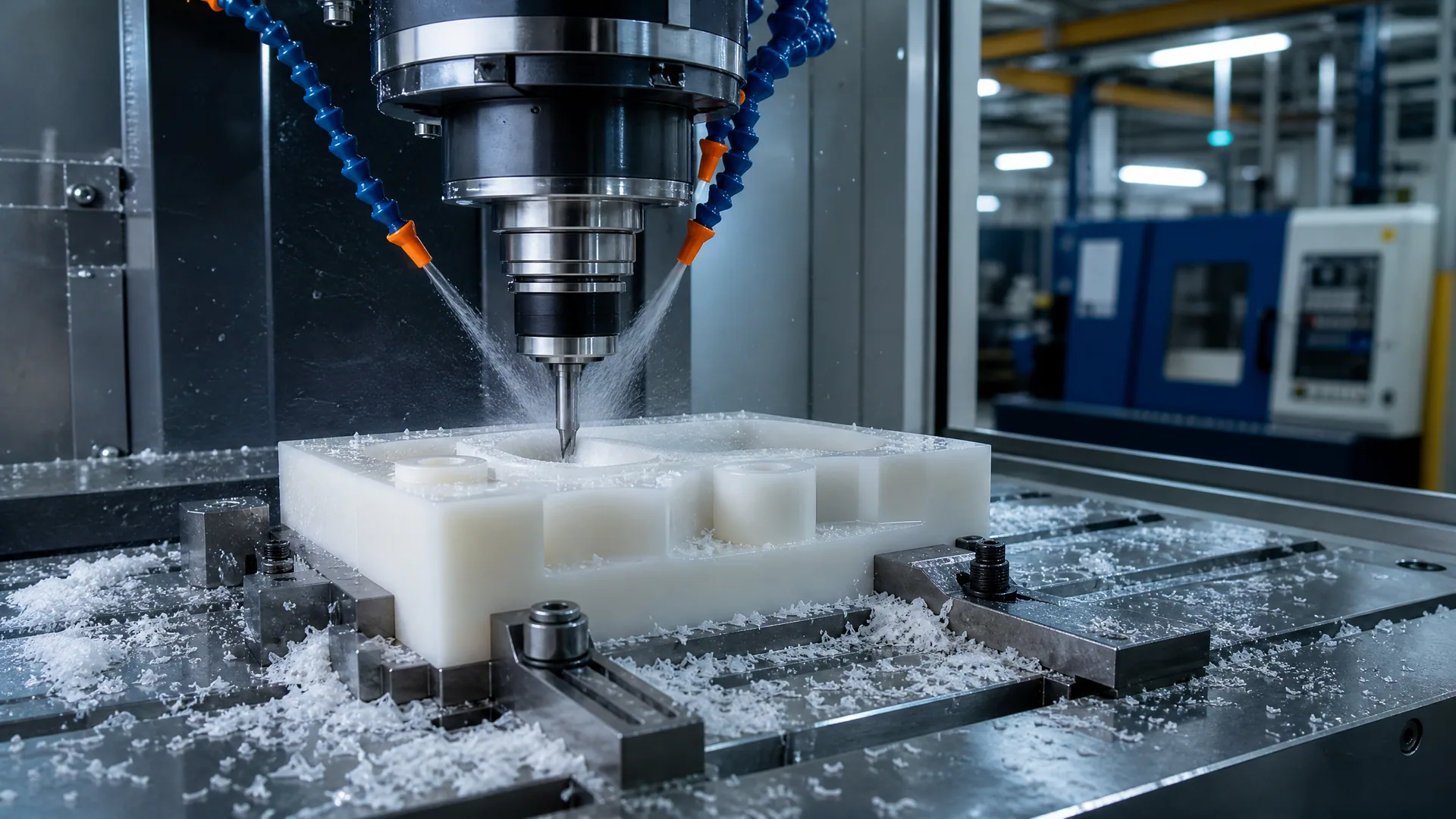
What is nylon CNC machining?
Nylon CNC machining is a subtractive process that mills or turns parts from solid polyamide stock. It is used for low-friction, wear-resistant and electrically insulating components such as gears, rollers, bushings, guide blocks and structural spacers.
Nylon is strong and fatigue resistant for its weight, but it is hygroscopic. It absorbs moisture from air or water, which can change dimensions and mechanical behavior after machining. A reliable supplier therefore reviews the nylon grade, moisture state, operating humidity, temperature, fits and inspection condition before committing to a tight tolerance.
CNC machining is especially useful for prototypes, bridge production, replacement parts and low-to-medium volumes that do not justify injection-mold tooling.
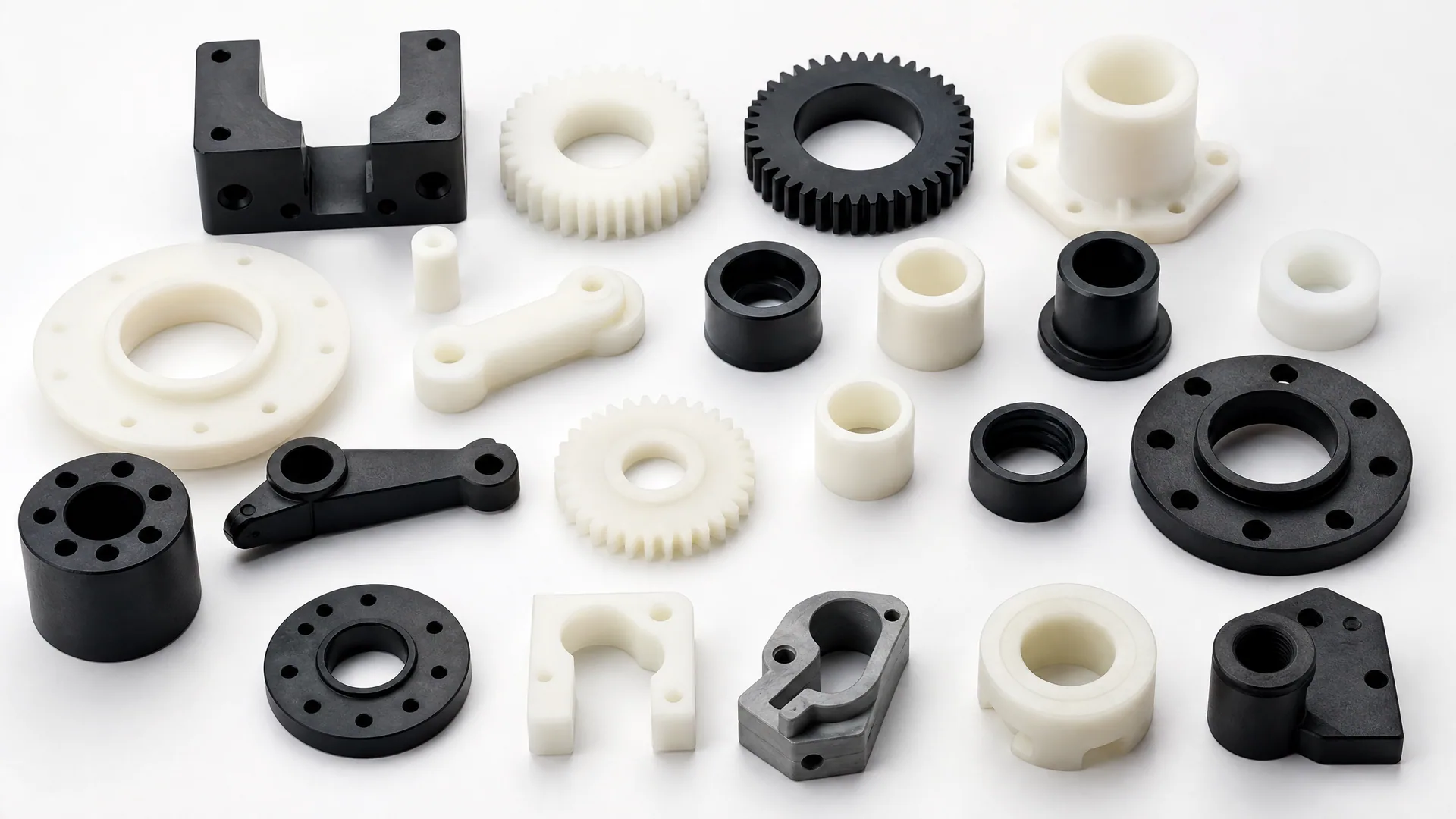
CNC processes for machined nylon parts
The process plan is selected around geometry, stock form, tolerance, quantity and the risk of heat or stress release.
CNC milling
Pockets, profiles, slots, counterbores, sealing faces and multi-sided features in plate, sheet or block stock.
CNC turning
Bushings, rollers, sleeves, spacers, pulleys and stepped diameters produced from rod or tube.
Drilling & threading
Peck drilling, tapped holes, counterbores and insert preparation with chip evacuation planned for stringy nylon chips.
Multi-axis machining
Cross holes, compound angles and multiple faces with fewer re-clamps when geometry and volume support the method.
Need a manufacturability check?
Upload STEP or IGES plus a PDF drawing so we can review stock, setups, critical dimensions and inspection notes.
Nylon grades for CNC machining
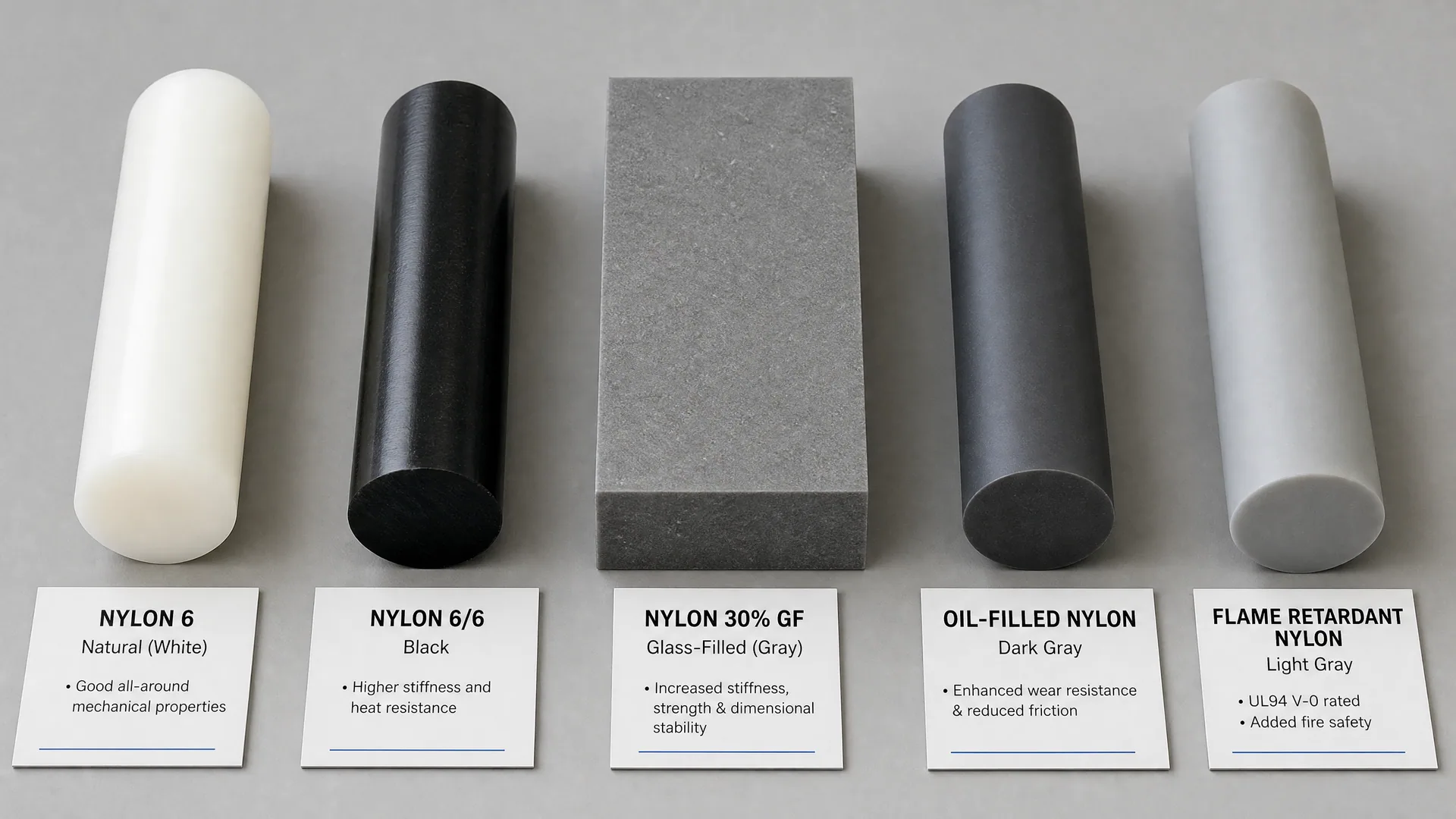
“Nylon” is a material family, not one fixed specification. Confirm the exact polymer, filler, color, stock form, conditioning state and compliance requirement before ordering.
| Grade | Why buyers select it | Machining and design considerations | Typical part examples |
|---|---|---|---|
| PA6 / Nylon 6 | Good toughness, impact behavior and value; cast stock is available in larger sections. | Higher moisture response than low-absorption plastics; large or asymmetric cuts may release stock stress. | Wear pads, large rollers, sheaves, guides |
| PA66 / Nylon 6/6 | Higher stiffness and heat capability than many unfilled PA6 grades; common for precision mechanical parts. | Still hygroscopic; tight fits must define measurement humidity and temperature. | Gears, bushings, spacers, electrical parts |
| Cast nylon / MC nylon | Useful for thick plate, large rod and near-net stock with good wear performance. | Stock history and internal stress matter on large sections; roughing and stabilization may be required. | Large pulleys, rollers, bearing blocks |
| PA12 | Lower moisture uptake and better dimensional stability than PA6/PA66, with useful toughness. | Lower stiffness and higher material cost may change the design decision. | Fluid-system parts, flexible mechanical components |
| Glass-filled nylon | Higher stiffness, creep resistance and dimensional stability. | Abrasive fibers increase tool wear and may expose fibers at machined surfaces; carbide tooling is normally preferred. | Structural brackets, precision housings, loaded supports |
| Oil- or MoS₂-filled nylon | Improved bearing and wear behavior for sliding applications. | Verify mating material, load, speed, temperature and lubricant compatibility. | Bushings, slide pads, wear strips, guide wheels |
Availability is project-specific. Regulatory, food-contact, flame, ESD or material-certification requirements must be stated before quotation.
Typical nylon properties—and why the datasheet matters
Values below are broad design references for common unfilled engineering grades. Fillers, colorants, conditioning, test method, temperature and supplier formulation can change the result. The approved supplier datasheet and customer drawing govern production.
- Low density helps replace heavier materials in moving assemblies.
- Wear resistance and damping suit gears, rollers and sliding parts.
- Moisture can reduce stiffness while improving toughness.
- Thermal expansion is much higher than most metals.
| Property | Typical reference range | Buyer implication |
|---|---|---|
| Density | About 1.12–1.15 g/cm³ | Lightweight versus aluminum or steel |
| Tensile strength, dry | Often about 70–90 MPa | Grade and moisture condition materially affect results |
| Melting range | Roughly 215–265°C by grade | Not the same as continuous service temperature |
| Equilibrium moisture | Often about 2–3.5% by weight for common PA6/PA66 at standard room conditions | May cause measurable growth from the dry state |
| Linear growth from moisture | Often around 0.5–0.9% for unfilled PA6/PA66 at equilibrium conditions | Can dominate a tight fit or tolerance stack |
Nylon machining tolerances and lead times
Tolerance capability is feature-specific. Part size, wall thickness, grade, moisture state, temperature, fixturing and inspection timing all matter.
General dimensions
±0.10 mm (±0.004 in) is a practical planning target for many machined nylon features, subject to drawing review.
Critical dimensions
±0.05 mm (±0.002 in) may be feasible on eligible features with a stable grade, suitable geometry and defined measurement condition.
Prototype lead time
Starting from 3–5 business days after CAD, drawing, material, quantity, finish and inspection requirements are confirmed.
| Lead-time driver | Why it matters | What to include with the RFQ |
|---|---|---|
| Material availability | Specialty, filled, colored or certified stock may require procurement. | Exact grade, color, stock form and certification |
| Part complexity | Multi-axis features, deep pockets and many setups add programming and machine time. | Native CAD plus dimensioned drawing |
| Conditioning or stabilization | Moisture or stress-control steps add controlled time but reduce dimensional risk. | Inspection state and operating environment |
| Inspection scope | FAI, dimensional reports, material certificates or special gauges require planning. | Inspection level and critical-feature list |
| Quantity | Fixtures, sampling plans and batch consistency change from prototype to production. | Prototype quantity and expected annual volume |
Managing moisture, heat and internal stress
Moisture is the defining tolerance risk in nylon machining. PA6 and PA66 absorb water from the environment. The part can grow, soften or change stiffness as it approaches equilibrium.
- Confirm whether dimensions apply in the dry or conditioned state.
- Use sharp, polished cutting edges to reduce rubbing and heat.
- Remove stringy chips before they wrap around the tool or workpiece.
- Use low-stress fixturing that supports the part without crushing it.
- Balance roughing cuts on large or asymmetric parts to reduce warpage.
- Allow stabilization before final inspection when the risk justifies it.
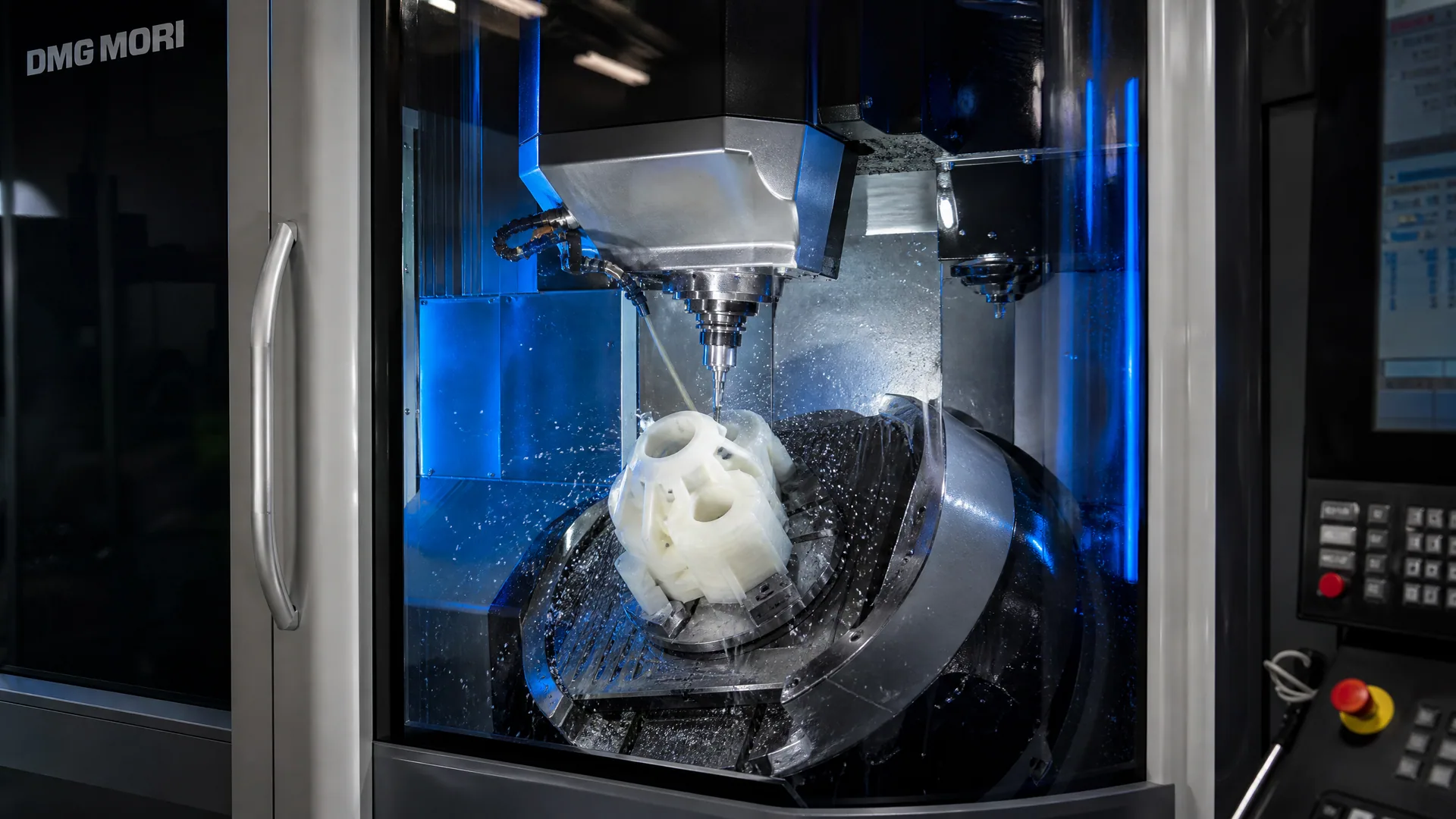
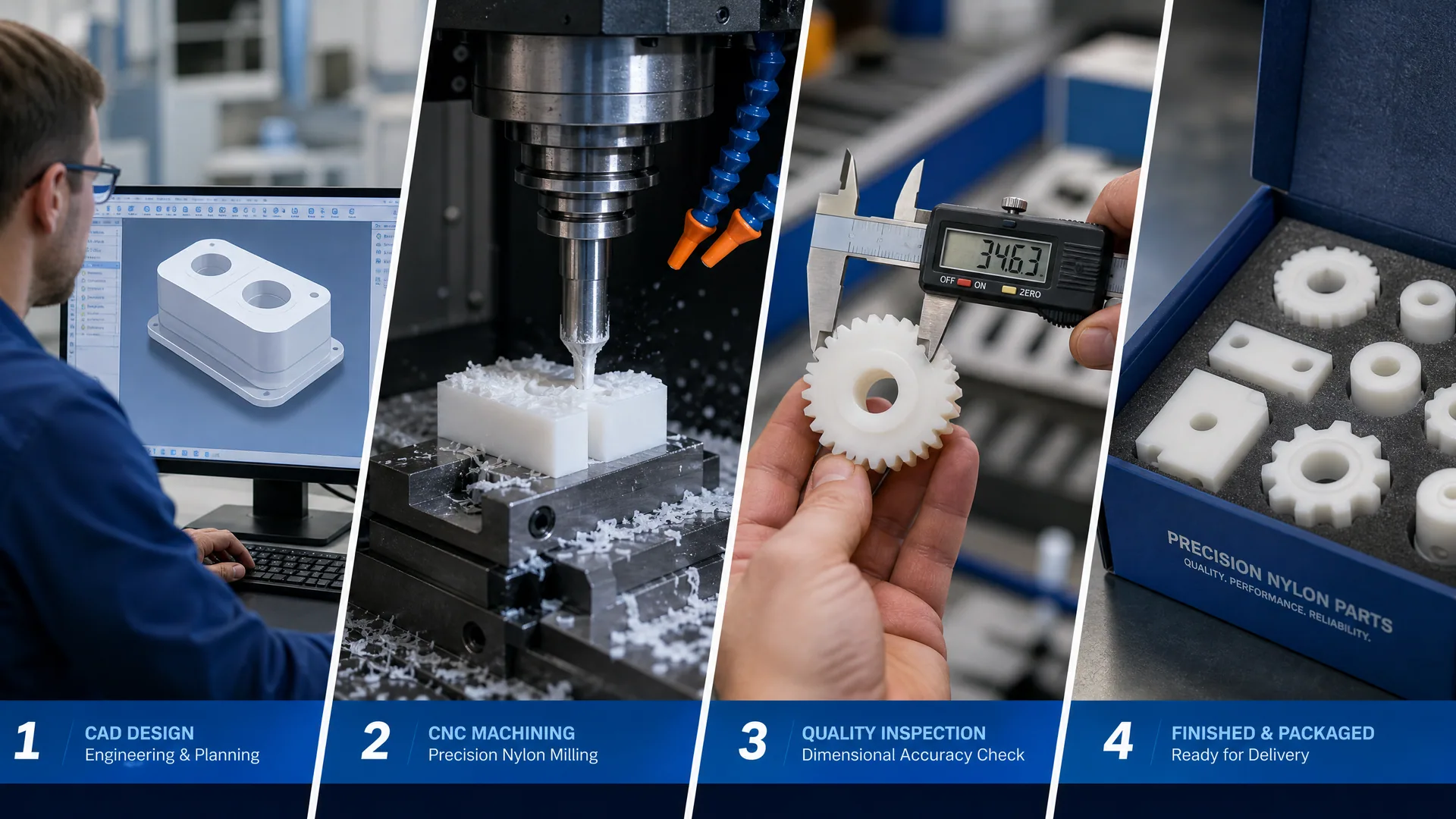
How we plan a nylon CNC machining project
From CAD review to finished parts
This machining video shows the type of controlled CNC workflow used across our precision-part projects. A nylon-specific process plan then adjusts tooling, workholding, chip evacuation and inspection for the approved PA grade.
For a useful quotation, provide the 3D model, 2D drawing, quantity, material specification and any critical fit, cosmetic or inspection requirement.
DFM guidelines for CNC machined nylon parts
| Design feature | Recommended approach | Risk if ignored |
|---|---|---|
| Wall thickness | Keep walls uniform and use generous support during machining. Review walls below about 1.0 mm individually. | Deflection, chatter, heat distortion or flatness loss |
| Internal corners | Use radii compatible with standard end mills; larger radii reduce tool reach and cycle time. | Extra tool changes, small cutters and higher cost |
| Deep pockets | Limit depth-to-width ratio where possible and leave clearance for chip evacuation. | Heat buildup, recutting chips and poor finish |
| Holes and threads | Provide adequate edge distance; specify thread engagement and consider inserts for repeated assembly. | Breakout, stripping, creep or chip packing |
| Flatness | Use balanced geometry and material removal; identify only truly functional flat surfaces. | Warp after unclamping or conditioning |
| Bore/shaft fits | Define clearance at service temperature and humidity, not only nominal room conditions. | Seizure, excess play or post-delivery rejection |
| Cosmetic surfaces | Mark appearance zones and acceptable tool marks on the drawing. | Unnecessary polishing or subjective disputes |
| Tolerance strategy | Use tight tolerances only on functional features and define the inspection state. | Higher cost without improved part performance |
Reduce risk before the first cut
We can flag tolerance, warpage, thread and material-selection issues during quotation.
Surface finish, color and quality documentation
As machined
Often the preferred functional finish. Sharp tools and stable cutting conditions help minimize fuzzing, smearing and visible tool marks.
Deburring & edge break
Manual or controlled mechanical methods remove burrs while protecting fits, threads and defined sharp edges.
Dyeing or marking
Some nylon grades accept dye or marking. Color, depth, adhesion and compatibility require sample or supplier review.
Inserts and assembly
Threaded inserts and hardware can be planned for repeated assembly, load distribution and creep resistance.
Dimensional inspection
Critical features can be checked by calibrated contact or optical methods appropriate to the part and tolerance.
Requested records
Material certificates, FAI or dimensional reports may be specified at RFQ stage and confirmed with the order.
Where machined nylon parts are used
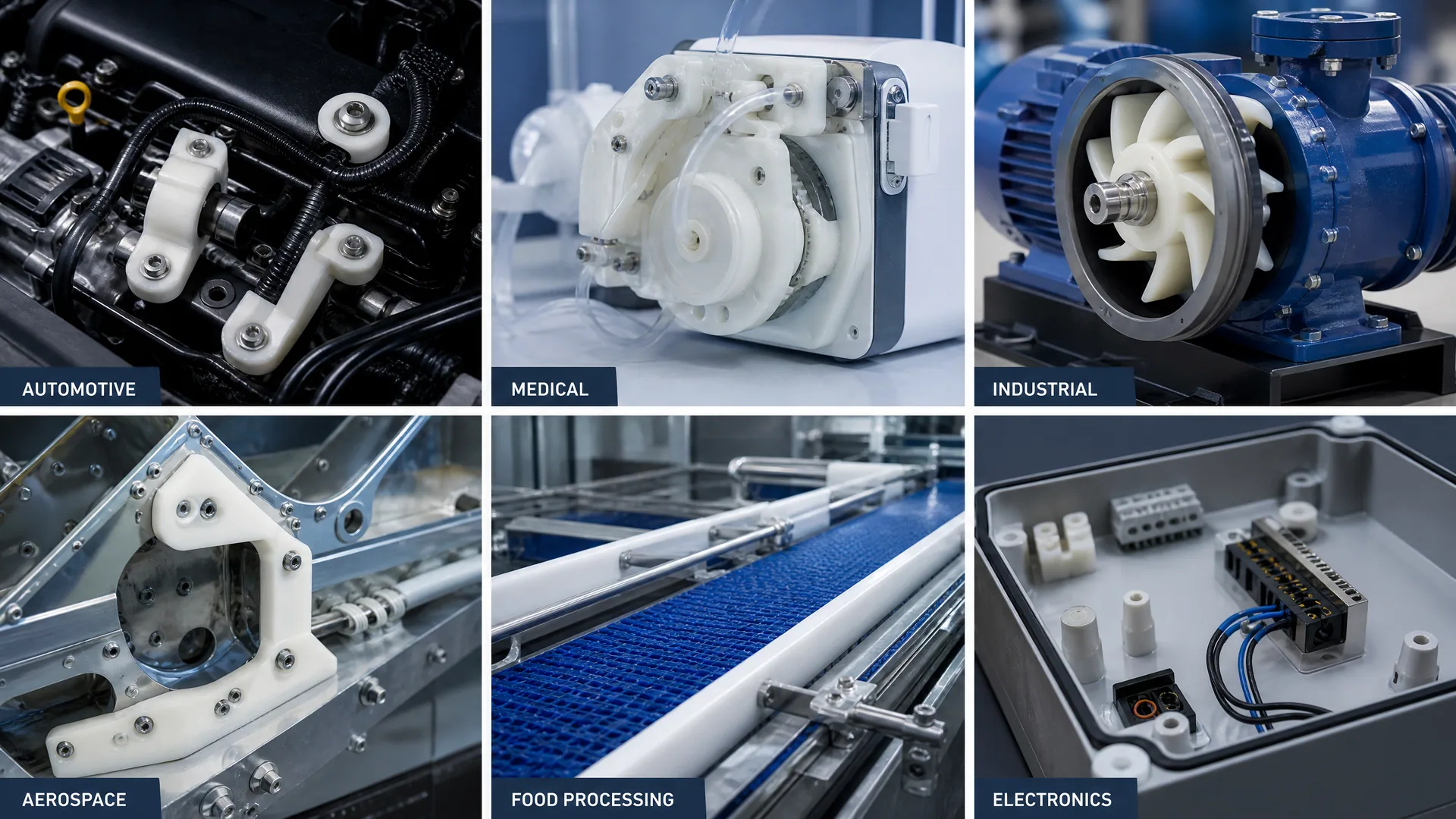
Nylon is commonly specified when a component needs low weight, wear resistance, useful strength, vibration damping or electrical isolation. Suitability still depends on load, speed, temperature, moisture, chemicals and mating materials.
Industrial equipment
Wear pads, guides, rollers, sheaves, spacers and protective components.
Automation
Low-noise gears, slide blocks, nests, fixtures and conveyor components.
Electrical systems
Insulators, terminal supports, standoffs and nonconductive hardware.
Transport equipment
Lightweight bushings, brackets, guides and abrasion-resistant mechanisms.
Nylon vs Delrin, PTFE, HDPE and polycarbonate
Select the material from the operating requirement, not from machinability alone.
| Material | Choose it when… | Watch for… |
|---|---|---|
| Nylon / PA | Wear, fatigue strength, damping and mechanical toughness are important. | Moisture-related growth and changing stiffness. |
| Delrin / POM | Dimensional stability, low moisture uptake and crisp precision features are priorities. | Lower impact toughness in some conditions and different chemical limits. |
| PTFE | Chemical resistance, low friction and high-temperature capability dominate. | Creep, softness and difficult tight-tolerance control. |
| HDPE | Low cost, chemical resistance and low moisture uptake matter more than stiffness. | High thermal expansion, softness and deflection. |
| Polycarbonate | Impact resistance, transparency or protective guarding is required. | Heat, stress cracking, haze and scratch sensitivity. |
What to send for an accurate nylon machining quote
Geometry
STEP, STP, IGES or X_T model plus a dimensioned PDF drawing.
Material
Exact PA grade, filler, color, stock form and any required certificate.
Demand
Prototype quantity, batch quantity and estimated annual usage.
Environment
Temperature, humidity, water exposure, chemicals, load, speed and mating material.
Acceptance
Critical dimensions, inspection state, cosmetic zones and reporting requirements.
Delivery
Required date, shipping location, packaging and any staged-delivery plan.
Ready for a quote?
A complete RFQ reduces clarification time and helps us give a realistic tolerance and delivery commitment.
Nylon CNC machining questions
What tolerance can CNC machining hold in nylon?
±0.10 mm is a practical general planning target for many features. ±0.05 mm may be feasible on eligible critical dimensions after reviewing grade, geometry, moisture condition, temperature and inspection method. Tighter values require feature-by-feature engineering review.
How fast can machined nylon prototypes be delivered?
Prototype lead time can start from 3–5 business days after CAD, drawing, material, quantity, finish and inspection requirements are confirmed. Special stock, conditioning, complex setups, extensive reporting or larger quantities can extend delivery.
Which nylon grade is best for CNC machining?
There is no universal best grade. PA66 is a common choice for stronger, stiffer precision components; PA6 and cast nylon are useful for tough wear parts and larger sections; PA12 reduces moisture sensitivity; glass-filled grades increase stiffness and dimensional stability but wear tools faster.
Does nylon change size after machining?
Yes. Common nylons absorb moisture and can expand after machining. The drawing should state the intended service environment and whether dimensions are inspected dry, sealed or after conditioning.
Can nylon replace metal parts?
Sometimes. Nylon can reduce mass, noise, corrosion and lubrication needs in gears, rollers, bearings and guides. Load, creep, temperature, moisture, stiffness, fire performance and safety factors must be checked before substitution.
Can glass-filled nylon be CNC machined?
Yes. Glass-filled nylon can improve stiffness and dimensional stability, but the fibers are abrasive and can affect tool life and surface appearance. Tooling, speeds and inspection must be selected for the exact grade.
Can you machine nylon gears, bushings and rollers?
Yes, these are common CNC nylon part families. The RFQ should define tooth geometry or bore fit, load, speed, mating material, lubrication, temperature and humidity so the grade and clearances can be reviewed.
What files are needed for a quote?
Send a 3D CAD file, a 2D drawing with critical dimensions, the material grade, quantity, required delivery date, finish, inspection needs and information about the operating environment.
Continue planning your plastic part
Explore our CNC machining services, CNC milling services, CNC turning services, Delrin CNC machining, PTFE machining, polycarbonate machining and acrylic CNC machining.
Get a drawing-specific nylon CNC machining quote
Upload your CAD, drawing, material specification and quantity. We will review geometry, moisture-sensitive tolerances, inspection requirements and a realistic delivery plan before production.