Aluminum Anodizing:
The Complete Guide to Process, Types & Benefits
Discover everything about aluminum anodizing — from the electrochemical science behind the process to Type I, II, and III specifications, alloy compatibility, color options, and industry applications. MyBestMachining delivers precision anodizing services that meet the most demanding aerospace, automotive, and industrial standards.
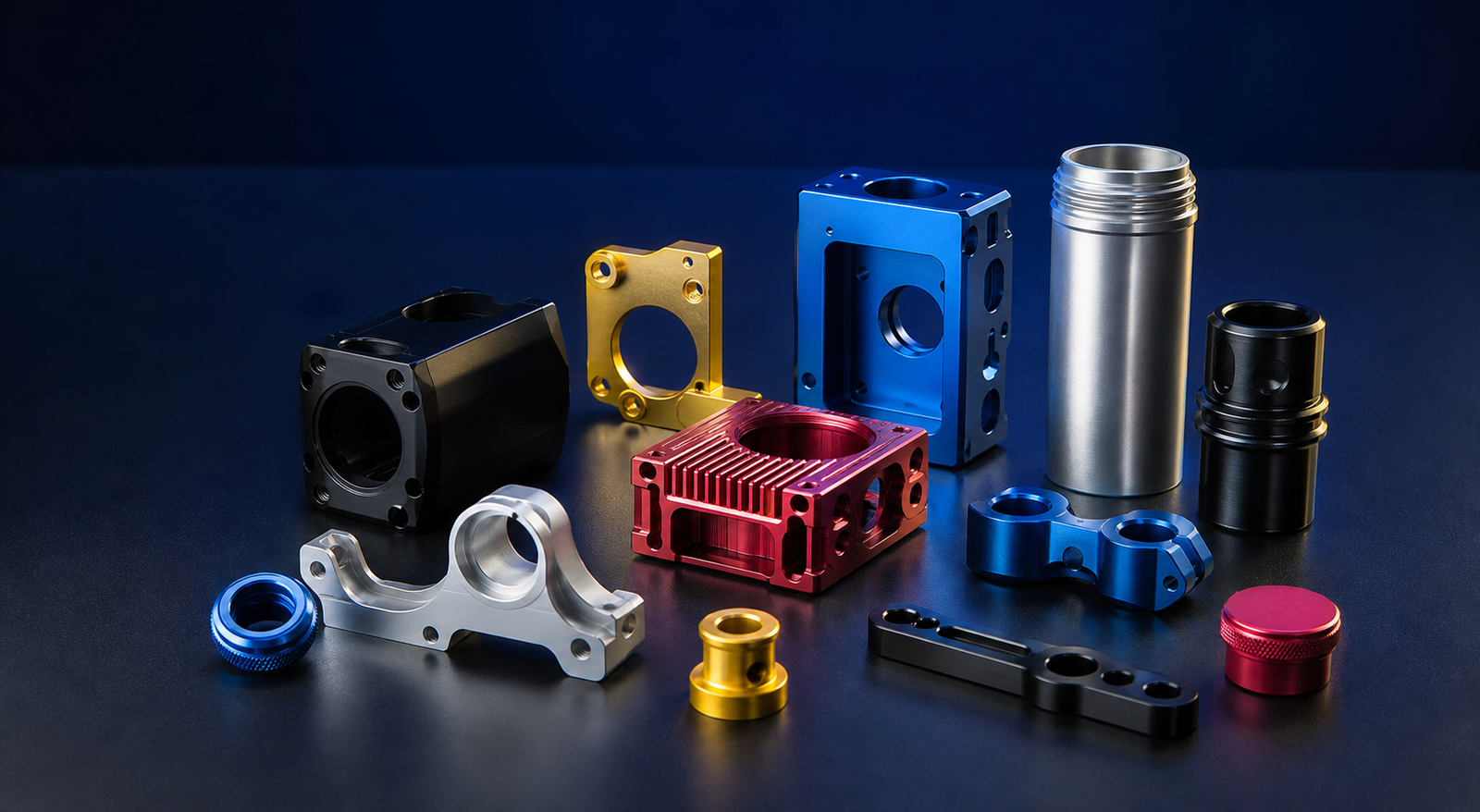
What is Aluminum Anodizing?
Aluminum anodizing is an electrochemical process that converts the metal surface into a decorative, durable, corrosion-resistant anodic oxide finish. The term “anodizing” comes from the fact that the aluminum part acts as the anode (positive electrode) in an electrolytic cell during the process.
Unlike paint or plating, which are applied coatings that sit on top of the metal, the anodized layer is an integral part of the aluminum itself. The oxide layer grows both outward from and inward into the metal surface, making it impossible to chip, flake, or peel under normal service conditions.
When aluminum is exposed to air, it naturally forms a very thin oxide layer (2–3 nm) that provides some protection. The anodizing process dramatically thickens this layer — up to 150 µm for hard coat applications — creating a highly ordered, porous structure that can be dyed and sealed for both functional and decorative purposes.
Key Fact: The anodized oxide layer is formed by the aluminum itself — the aluminum atoms on the surface react with oxygen ions from the electrolyte to form aluminum oxide (Al₂O₃). This means the finish is chemically bonded to the substrate, not merely adhered to it.
Need anodizing for your CNC machined aluminum parts?
Review Your Anodizing Requirements →How the Aluminum Anodizing Process Works
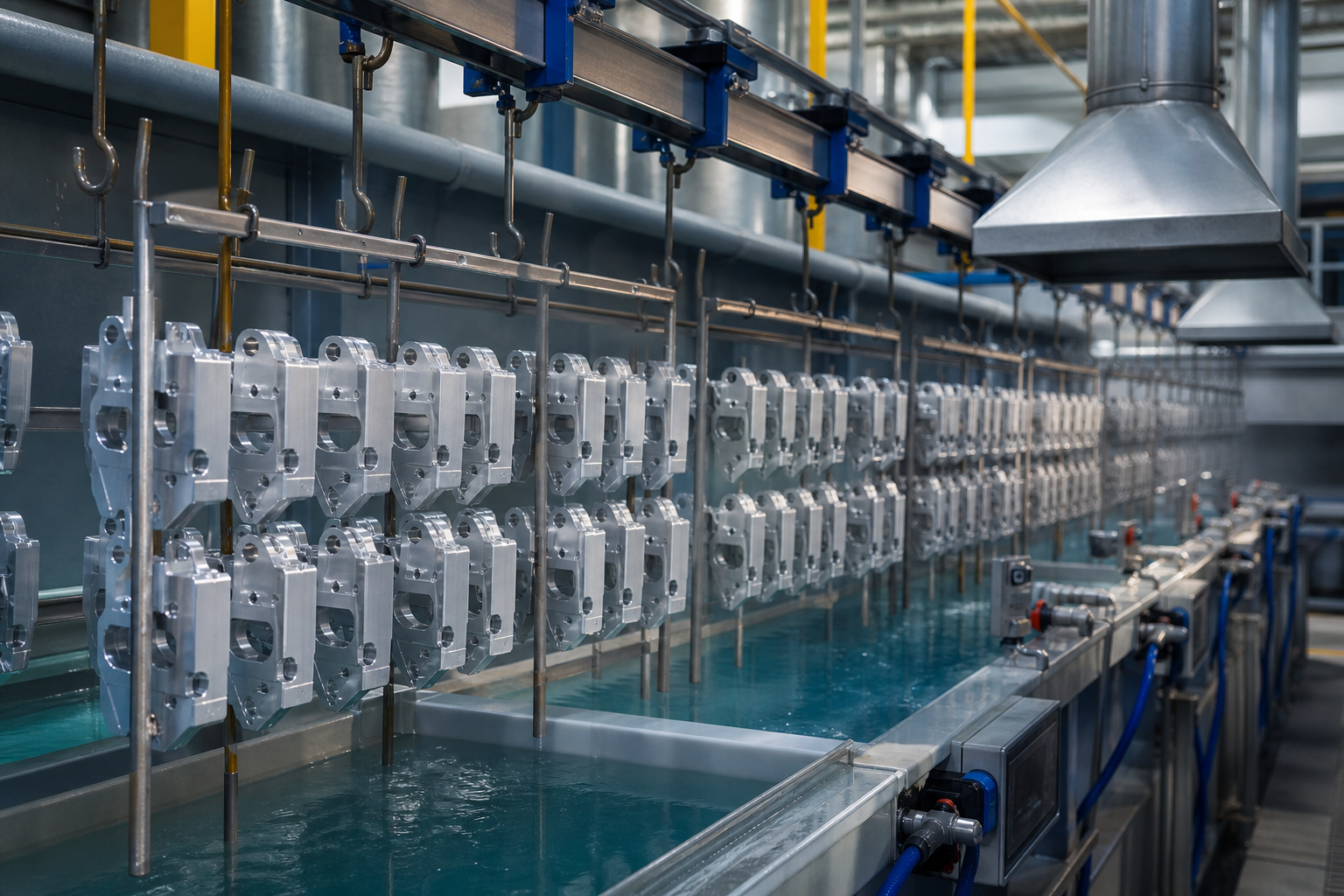
The anodizing process is a precisely controlled, multi-stage electrochemical procedure. Each step is critical to achieving a consistent, high-quality anodic oxide layer that meets your performance requirements.
Electrochemical Parameters
Precise control of these parameters determines the coating thickness, hardness, and quality of the final anodized layer.
| Parameter | Type II | Type III (Hard Coat) |
|---|---|---|
| Electrolyte | H₂SO₄ (15–20%) | H₂SO₄ (10–15%) |
| Temperature | 18–22°C (64–72°F) | 0–5°C (32–41°F) |
| Voltage | 15–21 V DC | 25–100 V DC |
| Current Density | 1–2 A/dm² | 2–4 A/dm² |
| Time | 20–60 min | 60–120 min |
| Coating Rate | ~0.4 µm/min | ~1.0 µm/min |
The Science of Oxide Layer Formation
Understanding the microstructure of the anodic layer reveals why it performs so exceptionally.
The anodic oxide layer has a unique two-layer structure: a thin, dense barrier layer at the base, topped by a thick, porous outer layer. The pores are cylindrical, 10–150 nm in diameter, and perpendicular to the surface. This porous structure is what allows dyes to be absorbed and lubricants to be retained.
The chemical reaction at the anode surface is:
2Al + 3H₂O → Al₂O₃ + 6H⁺ + 6e⁻
The nanopores (10–150 nm diameter) allow the electrolyte to continue dissolving and re-forming the oxide, enabling the layer to grow to much greater thicknesses than natural passivation.
Need anodizing for your CNC machined aluminum parts?
Plan Your Anodizing Process →Types of Aluminum Anodizing
Choosing the right anodizing type is critical to achieving the desired performance and aesthetic for your components. Each type is defined by its electrolyte, coating thickness, and resulting properties.
Chromic Acid Anodizing
Electrolyte: Chromic Acid (H₂CrO₄) · Thickness: 0.5–18 µm · Standard: MIL-A-8625 Type I / AMS 2470
Type I, or Chromic Acid Anodizing, is the oldest anodizing process, first used industrially in 1923. It uses chromic acid as the electrolyte to produce the thinnest anodic coating of the three principal types. Despite its thinness, when properly sealed, it provides corrosion protection comparable to thicker coatings.
The resulting coating is softer and more ductile than sulfuric acid coatings, making it ideal for complex shapes, welded assemblies, and tight-tolerance parts where dimensional change must be minimized. It also provides excellent adhesion for subsequent paint or primer applications.
Note: Due to environmental and health concerns associated with hexavalent chromium (Cr⁶⁺), Type I is increasingly being replaced by Boric-Sulfuric Acid Anodize (BSAA) in aerospace applications.
Sulfuric Acid Anodizing
Electrolyte: Sulfuric Acid (H₂SO₄) · Thickness: 1.8–25 µm · Standard: MIL-A-8625 Type II / AMS 2471 / AMS 2472
Type II Sulfuric Acid Anodizing is by far the most widely used anodizing process, accounting for the vast majority of commercial anodizing work. It produces a thicker, harder, and more porous coating than Type I, making it excellent for both protective and decorative applications.
The high porosity of Type II coatings makes them ideal for dyeing, allowing a wide spectrum of vibrant, durable colors. The process is also more cost-effective than Type I or III, as sulfuric acid is less expensive than chromic acid, and the process requires less energy and time.
Type II is available in two classes: Class 1 (Non-Dyed) for a clear, natural metallic finish, and Class 2 (Dyed) for colored finishes.
Hard Coat Anodizing (Hardcoat)
Electrolyte: Cold Sulfuric Acid (H₂SO₄) · Thickness: 25–150 µm · Standard: MIL-A-8625 Type III / AMS 2469
Type III Hard Coat Anodizing is the most robust and wear-resistant anodizing process available. While it uses the same sulfuric acid electrolyte as Type II, it operates at significantly lower temperatures (near freezing), higher voltages, and higher current densities, resulting in a much thicker and denser oxide layer.
The resulting coating can be harder than tool steel (up to 70 Rockwell C), making it the ideal choice for components subjected to extreme wear, abrasion, and harsh environmental conditions. It is widely used in aerospace, military, and heavy industrial applications.
Due to the density and thickness of the coating, Type III anodizing tends to darken the aluminum. It can be dyed, but color options are more limited, typically to black and dark shades. It also provides excellent electrical insulation.
Boric-Sulfuric Acid Anodizing (BSAA)
Electrolyte: Boric Acid + Sulfuric Acid · Thickness: 1.8–5 µm · Standard: MIL-A-8625 Type Ic / Boeing BAC 5632
Boric-Sulfuric Acid Anodizing (BSAA) was developed as an environmentally responsible alternative to Type I Chromic Acid Anodizing. It eliminates the use of hexavalent chromium (Cr⁶⁺), a known carcinogen, while providing equivalent or superior performance for aerospace applications.
BSAA produces a thin, non-porous coating that provides excellent corrosion protection and paint adhesion, particularly for aircraft and aerospace structural components. It is covered by Boeing’s BAC 5632 specification and is increasingly mandated by major aerospace OEMs as a replacement for chromic acid anodizing.
Need anodizing for your CNC machined aluminum parts?
Choose the Right Anodizing Type →Aluminum Anodizing Technical Specifications
A comprehensive comparison of all major aluminum anodizing types, their technical parameters, and performance characteristics to help you make the right selection for your application.
| Specification / Property | Type I Chromic Acid | Type II Sulfuric Acid ★ | Type III Hard Coat | BSAA Type Ic |
|---|---|---|---|---|
| MIL-A-8625 Designation | Type I / IB | Type II | Type III | Type Ic |
| Electrolyte | Chromic Acid (H₂CrO₄) | Sulfuric Acid (H₂SO₄) | Cold Sulfuric Acid | Boric + Sulfuric Acid |
| Coating Thickness (µm) | 0.5 – 18 | 1.8 – 25 | 25 – 150 | 1.8 – 5 |
| Coating Thickness (inches) | 0.00002″ – 0.0007″ | 0.00007″ – 0.001″ | 0.001″ – 0.006″ | 0.00007″ – 0.0002″ |
| Hardness (Vickers HV) | 200 – 400 | 300 – 500 | 400 – 700 | 200 – 400 |
| Corrosion Resistance | Excellent | Very Good | Superior | Excellent |
| Wear / Abrasion Resistance | Good | Good | Excellent | Good |
| Electrical Insulation | Good | Good | Excellent | Good |
| Color / Dyeing Options | Limited (black only) | Excellent (full range) | Limited (dark shades) | Clear / limited |
| Dimensional Change per Surface | Minimal (<0.5 µm) | Low (0.9–12.5 µm) | Significant (12.5–75 µm) | Minimal |
| Paint Adhesion | Excellent | Very Good | Good | Excellent |
| Environmental Concerns | Cr⁶⁺ (hazardous) | Low (recyclable) | Low (recyclable) | None (Cr⁶⁺ free) |
| Relative Cost | Medium | Low (most economical) | High | Medium |
| Typical Bath Temperature | 35–42°C (95–108°F) | 18–22°C (64–72°F) | 0–5°C (32–41°F) | 21–27°C (70–80°F) |
| Typical Voltage Range | 0–40 V (ramped) | 15–21 V DC | 25–100 V DC | 10–15 V DC |
| Key Aerospace Specs | AMS 2470, DEF STAN 03-24 | AMS 2471, AMS 2472 | AMS 2469, ISO 10074 | Boeing BAC 5632 |
★ Type II is the most commonly specified anodizing process for general commercial and industrial applications.
Need anodizing for your CNC machined aluminum parts?
Confirm Your Technical Specification →Key Benefits of Aluminum Anodizing
Anodizing transforms aluminum from a good material into an exceptional one. The process enhances nearly every performance characteristic of aluminum, making it the preferred finishing choice across demanding industries worldwide.
Superior Corrosion Resistance
The sealed anodic oxide layer provides a robust, non-porous barrier against moisture, salt spray, acids, and environmental pollutants. Anodized aluminum can withstand 1,000+ hours of salt spray testing (ASTM B117), far exceeding untreated aluminum.
Exceptional Wear & Abrasion Resistance
The anodic oxide layer is significantly harder than the base aluminum. Type III hard coat anodizing can achieve hardness values of 400–700 HV — harder than tool steel — dramatically extending the service life of wear-critical components like pistons, gears, and valve bodies.
Aesthetic Versatility & Color Stability
Anodizing offers a wide spectrum of vibrant, permanent colors. Because the dye is absorbed into the porous oxide layer before sealing, the color becomes an integral part of the finish — it will not chip, peel, or fade under UV exposure like paint, maintaining its appearance for decades.
Excellent Electrical Insulation
Aluminum oxide (Al₂O₃) is an excellent electrical insulator with a dielectric strength of approximately 20–30 MV/m. This makes anodized aluminum ideal for electronic enclosures, heat sinks, and components requiring electrical isolation from their mounting surfaces.
Integral, Non-Delaminating Finish
Unlike paint or powder coating, the anodized layer is chemically bonded to the aluminum substrate. It cannot delaminate, blister, or separate from the base metal under mechanical stress, thermal cycling, or impact — making it far more reliable in demanding service environments.
Improved Thermal Properties
The anodized layer has a higher thermal emissivity (0.77–0.95) compared to bare aluminum (0.05–0.15), significantly improving heat dissipation. This makes anodized aluminum the material of choice for heat sinks, LED lighting fixtures, and thermal management components in electronics.
Long Service Life & Low Maintenance
Anodized finishes are extremely durable and require minimal maintenance. The hard, smooth surface resists staining, fingerprints, and everyday wear. Cleaning typically requires only mild soap and water, and the finish will maintain its appearance for decades even in harsh outdoor environments.
Biocompatibility & Food Safety
Anodized aluminum is chemically stable, non-toxic, and biocompatible. The aluminum oxide finish does not react with food or beverages, making it safe for cookware, food processing equipment, and medical devices. It can also withstand repeated sterilization cycles required in medical applications.
Environmentally Sustainable
Anodizing is a more environmentally responsible process than electroplating or painting. It uses water-based chemistry, produces no heavy metal waste, and the resulting anodized aluminum is fully recyclable. The process also complies with RoHS directives when chromic acid is not used.
Need anodizing for your CNC machined aluminum parts?
Improve Your CNC Machined Parts →Anodizing Colors & Finishes
One of the most compelling aspects of aluminum anodizing is the ability to achieve vibrant, permanent colors and a variety of surface finishes. The porous anodic oxide layer acts as a microscopic sponge, readily absorbing organic dyes before the pores are sealed — locking the color permanently into the surface.
Unlike paint, anodized colors are fade-resistant, UV-stable, and will never chip or peel. The final color appearance is influenced by the aluminum alloy, the thickness of the oxide layer, and the type of dye used. Alloys with high purity (1xxx series) and the 5xxx and 6xxx series produce the clearest and most vibrant colors.
For architectural applications requiring extreme color stability, electrolytic coloring (also called two-step anodizing) deposits metallic salts (tin, nickel, cobalt) into the pores, producing bronze and black tones that are highly resistant to UV degradation and are specified for exterior building facades.
Available Surface Finishes
| Finish Type | Process | Appearance |
|---|---|---|
| Matte / Satin | Chemical etch before anodizing | Non-reflective, frosted, hides machining marks |
| Bright / Mirror | Bright dip (chemical polish) before anodizing | Highly reflective, mirror-like, premium decorative |
| Brushed | Mechanical brushing before anodizing | Directional grain, popular for electronics & consumer goods |
| Bead Blasted | Bead blasting before anodizing | Uniform matte texture, hides imperfections |
| Clear / Natural | Standard anodize, no dye | Retains metallic aluminum appearance with enhanced protection |
Standard Color Palette
Custom colors available upon request. Final color may vary by alloy and coating thickness.
Need anodizing for your CNC machined aluminum parts?
Select Your Anodized Color →Best Aluminum Alloys for Anodizing
While most aluminum alloys can be anodized, the alloy composition significantly impacts the quality, color, and uniformity of the final anodic coating. Selecting the right alloy from the start ensures optimal anodizing results.
| Alloy Series | Common Grades | Primary Alloying Element | Anodizing Quality | Color Clarity | Typical Applications | Notes |
|---|---|---|---|---|---|---|
| 1xxx Series | 1100, 1050, 1060 | Pure Aluminum (≥99%) | Excellent | Excellent | Decorative, reflectors, chemical equipment | Produces the clearest, most vibrant colors. Best for bright dip anodizing. |
| 5xxx Series | 5052, 5083, 5086 | Magnesium (Mg) | Excellent | Good | Marine, automotive, pressure vessels | Produces a clear, strong coating. May show slight grayish tint at higher Mg content. |
| 6xxx Series | 6061, 6063, 6082 | Magnesium + Silicon (Mg-Si) | Excellent | Good | Architecture, automotive, consumer electronics, structural | Most popular for anodizing. 6063 produces the clearest finish; 6061 is slightly darker. |
| 2xxx Series | 2024, 2014, 2219 | Copper (Cu) | Fair | Fair | Aerospace structural components | High Cu content causes yellowish/brownish tint and may reduce corrosion resistance of anodic layer. Requires careful process control. |
| 7xxx Series | 7075, 7050, 7068 | Zinc (Zn) | Good | Fair | Aerospace, high-strength structural | Can produce a good protective coating, but color uniformity may be inconsistent. Requires low-temperature hard coat for best results. |
| 3xxx Series | 3003, 3105 | Manganese (Mn) | Good | Good | Roofing, siding, heat exchangers | Produces a good protective coating with moderate color clarity. Suitable for architectural applications. |
| Casting Alloys | 380, 356, A380 | Silicon (Si) | Poor | Poor | Die castings, automotive castings | High Si content produces a dark gray to black, non-uniform coating. Not recommended for decorative anodizing. |
Expert Recommendation: For the best combination of mechanical properties, machinability, and anodizing quality, 6061-T6 is the most widely specified alloy for precision CNC machined parts requiring anodizing. For architectural extrusions, 6063-T5/T6 provides the clearest and most consistent anodized finish. Contact our team for alloy selection guidance specific to your application.
Need anodizing for your CNC machined aluminum parts?
Check Your Aluminum Alloy →Aluminum Anodizing Applications by Industry
The unique combination of durability, corrosion resistance, and aesthetic flexibility makes anodized aluminum indispensable across a wide range of industries. MyBestMachining serves the most demanding sectors with precision anodizing solutions.
Aerospace & Defense
Anodizing is critical for aircraft structural components, where the combination of lightweight aluminum and superior corrosion/wear resistance is essential. Type III hard coat and BSAA are the dominant processes, meeting stringent MIL and AMS specifications.
Automotive
From decorative trim to high-performance engine components, anodizing provides automotive parts with the durability and aesthetics required for both interior and exterior applications, including resistance to road chemicals and UV exposure.
Architecture & Construction
Anodized aluminum is the material of choice for architectural applications due to its exceptional resistance to UV degradation, weathering, and color stability. Electrolytic coloring provides the long-term color stability required for exterior facades.
Consumer Electronics
The premium look, feel, and durability of anodized aluminum has made it the defining finish for high-end consumer electronics. It provides a scratch-resistant, non-conductive, and aesthetically superior casing that consumers associate with quality.
Medical Devices
Anodized aluminum’s biocompatibility, corrosion resistance, and ability to withstand repeated sterilization make it ideal for medical applications. The hard, smooth surface also resists bacterial adhesion, contributing to hygienic performance.
Industrial Machinery
In industrial environments, hard coat anodizing provides aluminum components with the extreme wear resistance and low friction properties needed to withstand demanding service conditions, reducing maintenance costs and extending equipment life.
Need anodizing for your CNC machined aluminum parts?
Get a Quote for Your Application →Aluminum Anodizing vs. Other Surface Finishes
Understanding how anodizing compares to alternative finishing methods is key to making the right choice for your application. Each finish has its strengths, but anodizing offers a unique combination of properties that is difficult to match.
| Property | Anodizing ★ | Powder Coating | Wet Paint | Electroplating (Chrome) | Conversion Coating |
|---|---|---|---|---|---|
| Coating Type | Integral (part of metal) | Applied (thermoplastic) | Applied (liquid film) | Applied (metallic layer) | Integral (chemical conversion) |
| Can Chip or Peel? | ✓ No | ~ Can chip at edges | ✗ Yes | ~ Can flake | ✓ No |
| Hardness | Very High (up to 70 HRC) | Moderate | Low | High (hard chrome) | Low |
| Corrosion Resistance | Excellent | Very Good | Good (if intact) | Excellent (hard chrome) | Good (as primer) |
| Wear Resistance | Excellent (Type III) | Good | Poor | Excellent | Poor |
| Color Options | Wide range (translucent) | Unlimited (opaque) | Unlimited (opaque) | Limited (metallic) | Clear, yellow, gold |
| Metallic Appearance | ✓ Retained | ✗ Hidden | ✗ Hidden | ✓ Metallic look | ✓ Retained |
| Dimensional Impact | Minimal (controlled) | Significant (50–100 µm) | Moderate (25–75 µm) | Significant (varies) | Negligible |
| Electrical Insulation | ✓ Excellent | ✓ Good | ✓ Good | ✗ Conductive | ~ Low resistance |
| Heat Resistance | Very High (~2050°C) | Moderate (~200°C) | Low (~150°C) | High | Moderate |
| Environmental Impact | Low (water-based) | Low (no VOCs) | High (VOCs, solvents) | High (heavy metals) | Medium (Cr⁶⁺ in some) |
| Relative Cost | Low–Medium | Low–Medium | Low | High | Low |
| Best For | Wear, corrosion, aesthetics, electronics | Decorative, outdoor, large parts | Complex shapes, unlimited color | Maximum wear resistance | Paint adhesion primer |
★ Anodizing is the recommended choice when maintaining the metallic nature of the part, achieving a hard and durable surface, or requiring electrical insulation.
Need anodizing for your CNC machined aluminum parts?
Compare Surface Finishing Options →Design & Tolerance Considerations for Anodizing
Successful anodizing begins at the design stage. Because the anodic oxide layer adds dimension to a part, it is essential to account for these changes to ensure final components meet their required tolerances. At MyBestMachining, our engineering team works closely with clients to address these considerations early, preventing costly rework.
The key principle to remember is that the anodizing process adds approximately half the coating thickness outward from the original surface and half penetrates inward into the aluminum substrate. For example, a 20 µm Type II coating will add 10 µm per surface to the part’s dimensions.
1 Dimensional Growth & Tolerances
Account for coating thickness in your design. For Type II anodizing (typical 12.5 µm), dimensions will increase by ~6 µm per surface. For Type III hard coat (typical 50 µm), dimensions increase by ~25 µm per surface. Machine parts to the lower end of the tolerance range to accommodate this growth, especially for mating parts and threaded features.
2 Edge Radii & Corner Geometry
Sharp corners and edges cause the anodic current to concentrate, leading to thin, non-uniform, or burned coatings at these points. Always specify a minimum radius of 0.5 mm (0.020″) on all external edges and corners. Internal radii should be as large as practical to ensure uniform coating growth and prevent stress concentrations.
3 Masking & Selective Anodizing
If certain areas must remain bare aluminum (e.g., electrical contact points, press-fit bores, or threaded inserts), specify masking on your engineering drawing. Masking adds cost and lead time, so minimize masked areas where possible. Clearly define masked regions with dimensions and tolerances on the drawing.
4 Threaded Features & Holes
Anodizing adds material to all surfaces, including the flanks of threads. For threaded holes that will receive fasteners, it is common practice to tap threads after anodizing, or to specify a slightly larger tap drill to accommodate the coating. Blind holes require drainage holes or venting to prevent acid entrapment.
5 Surface Preparation & Finish
The pre-anodize surface finish directly affects the final anodized appearance. Machining marks, scratches, and porosity will be visible after anodizing, as the process does not hide surface defects. Specify the required pre-anodize surface finish (Ra value) on your drawing. A bead blast or chemical etch can create a more uniform starting surface.
6 Welded Assemblies & Dissimilar Alloys
Anodizing welded assemblies is challenging because the weld filler alloy typically anodizes to a different color or appearance than the base material. If a uniform appearance is required, consider designing the part for anodizing before welding, or use a filler alloy that closely matches the base material’s anodizing characteristics.
Need anodizing for your CNC machined aluminum parts?
Upload Your Drawing for Review →Quality Standards & Specifications for Aluminum Anodizing
MyBestMachining’s anodizing processes are certified to the most widely recognized military, aerospace, and commercial standards. We provide full documentation and certifications with every order.
Military Specification for Anodic Coatings for Aluminum
The primary U.S. military specification for anodizing, covering Type I (Chromic Acid), Type IB, Type IC (BSAA), Type II (Sulfuric Acid), Type IIB, and Type III (Hard Coat). This is the most widely referenced standard for anodizing in the United States.
Hard Anodic Coating on Aluminum Alloys
Aerospace Material Specification covering hard anodic coatings (Type III equivalent) for aluminum alloys used in aerospace applications. Specifies coating thickness, hardness, and corrosion resistance requirements.
Anodic Treatment — Aluminum Alloys, Sulfuric Acid (Undyed)
Aerospace Material Specification covering undyed (Class 1) sulfuric acid anodizing for aluminum alloys. Specifies the requirements for the anodic coating thickness, appearance, and corrosion resistance.
Anodic Treatment — Aluminum Alloys, Sulfuric Acid (Dyed)
Aerospace Material Specification covering dyed (Class 2) sulfuric acid anodizing for aluminum alloys. Covers the same requirements as AMS 2471 with additional specifications for color fastness and dye uniformity.
Anodizing of Aluminium and Its Alloys — Hard Anodic Oxidation Coatings
International standard specifying requirements for hard anodic oxidation coatings on aluminum and its alloys. Covers coating thickness, hardness, abrasion resistance, and corrosion resistance for industrial applications.
Standard Specification for Anodic Oxide Coatings on Aluminum
ASTM standard covering anodic oxide coatings on aluminum, defining coating types A through H based on thickness and intended service environment, from decorative indoor use to severe outdoor exposure.
Boric-Sulfuric Acid Anodize (BSAA)
Boeing’s proprietary specification for Boric-Sulfuric Acid Anodizing, developed as a chromium-free alternative to chromic acid anodizing for aerospace structural components. Widely adopted across the commercial aerospace industry.
Quality Management System Certifications
MyBestMachining operates under a certified Quality Management System (ISO 9001:2015 and AS9100 Rev D for aerospace), ensuring consistent process control, traceability, and documentation for every anodizing order we process.
Need anodizing for your CNC machined aluminum parts?
Discuss Quality and Compliance →Frequently Asked Questions About Aluminum Anodizing
Find answers to the most common questions about the aluminum anodizing process, specifications, and capabilities.
Need anodizing for your CNC machined aluminum parts?
Ask an Anodizing Specialist →Ready to Anodize Your
Aluminum Parts?
Upload your CAD files and get an instant, competitive quote for professional aluminum anodizing services. Our team of experts is ready to help you select the right type, color, and specification for your application.